Table of Contents
- 1. Why Photos Aren’t Proof
- 2. A Day at the Factory With the Inspector
- 3. Why the Pakistan Route Magnifies Small Faults
- 4. What Gets Opened, Counted and Tested
- 5. Picking the Right Week for the Visit
- 6. Mistakes Buyers Keep Repeating
- 7. How Yiwa Logistics Handles Inspections
- 8. FAQs
- Conclusion
1. Why Photos Aren’t Proof
Say you run a small shop in Faisalabad and you’ve just placed your first China Wholesale order. The supplier’s catalogue looks smart, he answers WhatsApp in two minutes, and the courier sample is perfect. So you send the advance and tell your own customers the stock will be there by month-end.
Six weeks on, the container gets opened. Some cartons are crushed. One batch is darker than the sample. A few dozen pieces just don’t switch on. Your money is already with the supplier, and he’s a long way off.
None of this needed bad luck. What was missing was a second pair of eyes at the factory. That’s the whole idea behind a pre-shipment inspection. Somebody visits, cuts open cartons, counts the pieces, switches things on and takes photos. Spot a fault then, and the supplier still has every reason to repair it. Yiwa Logistics handles this from inside China. In this post I’ll walk through the process, explain why shipments headed to Pakistan benefit even more, and point out the errors buyers make again and again.
2. A Day at the Factory With the Inspector
An inspection happens late. The goods are made and boxed, but nothing has left the factory yet. He arrives carrying your purchase order and the sample you approved. Cartons stacked by the door are the easy pick, so he walks past them and pulls boxes from the top, the back and the bottom row. Every box he picks gets opened, and what’s inside is checked against your paperwork.
He’s really answering three questions. Is the quantity right? Does the product match the sample? Will the packing last through weeks of lifting and stacking?
One thing it won’t do: turn a bad supplier into a good one. A weak design stays weak too. Still, you leave with proof you can hold: pictures, actual measurements, and a report from a guy who had your cartons in his own hands. A chat reply saying everything’s fine just isn’t the same thing.
3. Why the Pakistan Route Magnifies Small Faults
Shipping always has some risk, but on this route several problems tend to land at once.
3.1. Distance works against you. In Yiwu, a wrong batch could be sorted over a two-day visit. After the cargo reaches a Karachi warehouse, the same problem becomes weeks of messages, and returning goods across the sea rarely makes financial sense.
3.2. Money leaves first. You pay a deposit at the start, then the supplier chases the balance just before the goods go out. Settle the remainder without checking, and the pressure you could have applied is gone. That pattern shows up in almost every China Wholesale deal, whatever its size.
3.3. Waiting time. Ocean freight, port work and customs all take days, sometimes more. A wrong batch means you have wasted all of that time too, while your buyers keep calling. Miss a peak season and the lost sales can exceed what the goods cost.
3.4. Rough handling. Cartons get a beating on this journey. They’re lifted onto trucks, stacked, unloaded at the port and stacked again. A thin carton that looked fine in the factory can arrive flat.
3.5. Document mismatches. A wrong label or a count that disagrees with the invoice can delay clearance at the port, and delays at the port usually come with charges nobody budgeted.
An inspection has a price. The trouble it prevents tends to cost a lot more.
4. What Gets Opened, Counted and Tested
One glance inside a single box isn’t inspecting anything. Inspectors don’t just wing it. They follow a checklist that’s written down, and they take cartons from all over the stack, not only the easy ones. How many pieces get checked is usually set by an AQL table. It’s a standard chart that links your lot size to a sample size, and to the number of defects that still counts as a pass.
4.1. Quantity count. Total pieces and total cartons must agree with your order. Nothing belonging to another customer should be sitting in your stack.
4.2. Finish and measurements. After the count, the inspector studies the product itself. He looks at shade, fabric or material, surface condition, seams and how clean the printing is. Then out come the tape and the scale. Dimensions and weight are measured and held against the agreed spec and the sample you approved earlier.
4.3. Trying the product out. Where possible the inspector powers it on or uses it. Skipping this for electronics, toys or motorised items is a real gamble, because a product can look immaculate and still be dead on arrival.
4.4. Cartons and marks. Breakable items usually get a drop test too. Better the carton splits on the factory floor than halfway to Karachi.
At the end, a report arrives with photos of acceptable and faulty pieces, a list of findings and the inspector’s clear opinion on whether the cargo can leave.
5. Picking the Right Week for the Visit
Many buyers simply say they will inspect “before shipping”. Being that loose about timing is exactly how inspection fees end up wasted.
Go too early and the result may reassure you for no good reason. Machines still running means part of your goods don’t exist yet. A good first few hundred units tells you nothing about the last thousand, and some factories rush or use cheaper materials once the inspector has gone.
Go late and there’s not much you can do. Once cartons are on the truck or the container door is shut, fixing anything turns into an argument about who pays and who waits.
The sweet spot is when about 80 to 100 percent of the goods are finished and most cartons are taped shut. Book it ahead of your final payment. Repairs can still be done at that point, and what you decide comes from what the inspector actually saw.
Here’s a free tip: let the supplier know in advance that someone is coming to inspect. Factories usually raise their standards once they know someone is going to look.
6. Mistakes Buyers Keep Repeating
Seasoned importers slip on one or two of these. First-timers collect most of them.
6.1. Saving the fee by skipping inspection is the classic. It seems smart right until 400 of 3,000 power banks turn out dead (a made-up example, not a real client).
6.2. Having no written standard is another. Nobody wrote down what “acceptable” means? Then you and the inspector are both guessing. Sort it out before production: approved samples, written specs, and a clear limit on defects.
6.3. Relying on photos only is a bet you’ll lose sooner or later. Photos show whatever the seller picked. Checking out the factory before you pay a deposit helps. Releasing the whole balance before you’ve seen the report throws the gain away.
6.4. Shipping despite a bad report. Some buyers receive a report full of problems and send the goods anyway because the deadline is close. Please don’t. At Yiwa Logistics we have watched buyers lose weeks to exactly this decision. A report full of serious problems means the cargo stays put. It leaves only when the supplier has fixed the faults, or when the goods have been checked a second time.
6.5. Combining suppliers with no plan. Problems love the gaps between suppliers. Inspect each supplier’s lot alone, and only then merge the cargo. Afterwards hold your documents, carton labels and shipping marks up against the real contents. If they disagree, sort it out before the container closes. A small mismatch is enough to hold a container at the port. Anyone doing China Wholesale for a living knows that habits like these protect margins better than a cheaper unit price does.
7. How Yiwa Logistics Handles Inspections
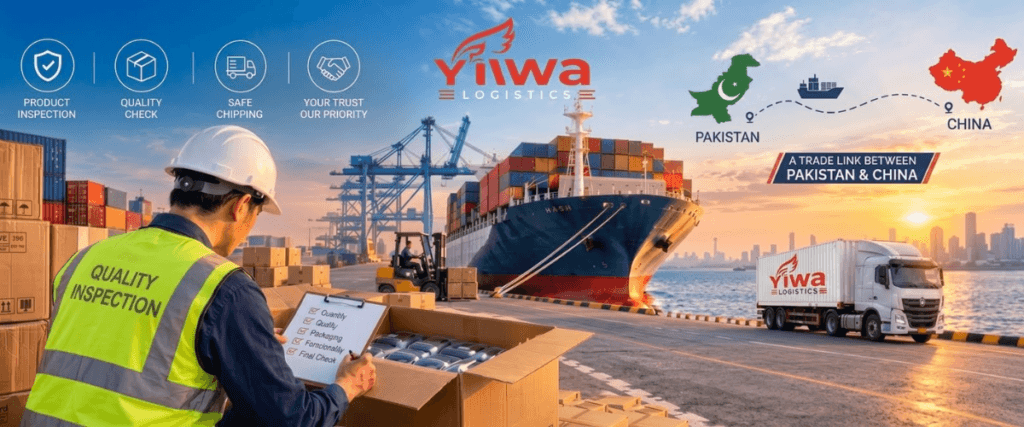
At Yiwa Logistics, inspection isn’t something we tack on afterwards. We live and work in China. When we tell you a product was checked, a member of our team had it in their hands. A factory’s own pictures are never our proof.
Start by telling us what you care about most. Specs, the sample you approved, and whatever rules the factory has to follow. All of it is put in writing. When production wraps up, one of our inspectors goes to the factory warehouse and cuts the cartons open. Your checklist drives everything: count, appearance, whether items work, packing quality. Photos and a short write-up follow. Your next move then depends on what our inspector actually observed.
If something is off, Yiwa Logistics tells you straight away. He’s told while the goods are still on his floor, which leaves time to correct the problem. Find out after the cargo reaches Pakistan and your options are poor and expensive.
Buying from a few different suppliers? We inspect each lot separately. Whatever passes goes into one combined shipment, and the same team follows it to your door.
8. FAQs
1. Do small orders really need an inspection?
That depends on how much damage a failed order would do to you. On a small, cheap China Wholesale order, the check may cost more than it saves. But if one ruined batch would hurt badly, pay for the check.
2. Can I relax if the report comes back clean?
Not quite. Opening every single box isn’t realistic, which means the report covers only the cartons that were examined. Use it as a good guide to the lot’s quality. It isn’t a guarantee for each piece.
3. Should the final payment wait for the report?
Wait. Pay once the report is in your hands. If something’s wrong, the money is still yours, and that’s your bargaining chip.
4. A supplier won’t let the inspector in. What then?
Be suspicious. If the goods are good, there’s nothing to hide, so there’s rarely a reason to refuse.
Conclusion
Done right, China Wholesale buying can grow a business quickly, but the goods have to show up as promised. With Pakistan-bound orders you’ve got distance, early payments and slow transit working against you, so mistakes are hard to undo later. An inspection is cheap next to what it protects, and at Yiwa Logistics it’s a standard part of the process, not an add-on.
Write the standards down before production starts. Time the inspection well. Then read the report properly and act on what it says. Do all that on every order, and nasty surprises turn rare.
Want help with inspection and sea freight for your next order? Visit yiwalogistics.com and talk to the Yiwa Logistics team today.